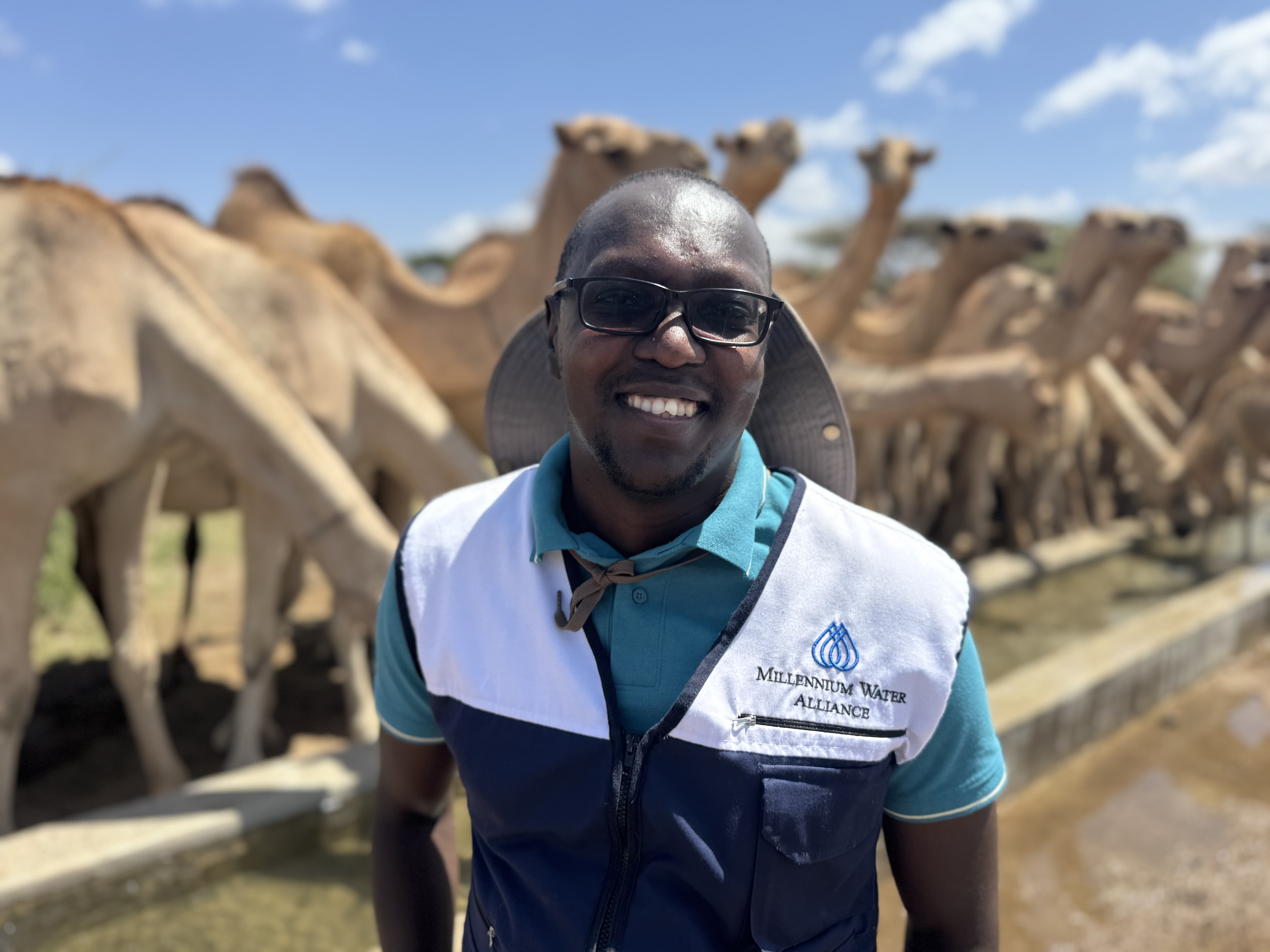
Styvers Kathuni
PhD Candidate, Civil Engineering – Civil Systems · University of Colorado Boulder
Styvers is a doctoral researcher at the Mortenson Center in Global Engineering at CU Boulder. He serves as Country Director for the Millennium Water Alliance (MWA) Kenya and Chief of Party for the USAID STAWI Mashinani Activity. His doctoral research focuses on the effectiveness and determinants of water security programs in northern Kenya, using the DRIP FUNDI borehole operation and maintenance program as a primary empirical case.
With over 15 years of experience in WASH project design and management across Africa, Styvers has held roles including Regional Director for Africa at SweetSense Inc., and positions with Save the Children, Catholic Relief Services, and Caritas Embu across Kenya and South Sudan. He has managed multi-year, multi-donor projects across Kenya, Ethiopia, and Nigeria, and was seconded to Kenya's Ministry of Water and Irrigation to support European Commission and IFAD-funded initiatives.
Styvers holds an MSc in Water Supply and Sanitation from Kenyatta University and a BSc in Water and Environmental Engineering from Egerton University.
This research evaluates the effectiveness and determinants of water security programs in northern Kenya's arid and semi-arid lands (ASAL), using the DRIP FUNDI borehole operation and maintenance program as a primary empirical case. The work spans three interconnected research questions: measuring program impact on borehole uptime, household water security, and water quality; identifying institutional, financial, and technological factors that drive effectiveness; and synthesizing findings with broader literature to generate actionable insights for climate-stressed communities.
The DRIP FUNDI Program
DRIP FUNDI is an operation and maintenance program targeting borehole water infrastructure across Kenya's northern ASAL counties. The program combines professional and community-based management with real-time sensor monitoring, inline chlorination, and performance-based financing to sustain water access for pastoralist and smallholder farming communities.
The program operates across five counties in northern Kenya:
Phase 1 — USAID BHA
200 boreholes across 5 counties. September 2023 – March 2025. USD 2M funding. Layering with RAPID+ and USAID STAWI Mashinani programs.
Phase 2 — Coca-Cola Foundation
60 boreholes. May – September 2025. USD 648K funding. Continued integration with RAPID+ program.
Theory of Change
DRIP FUNDI's theory of change posits that combining responsive operation and maintenance with real-time monitoring (Virridy sensors), inline water treatment (chlorination), performance-based financing, and locally accountable governance will achieve sustained borehole uptime, improved household water security, and reduced microbial contamination.
The program blends professional management by MWA technicians with community-level engagement through Borehole Rapid Response Teams (BRRTs) and Water Management Committees (WMCs). This hybrid model aims to address the systemic failures that cause high rates of borehole non-functionality across sub-Saharan Africa.
Research Framework
Hypothesis
DRIP FUNDI's operation and maintenance model combined with inline chlorination will increase borehole uptime, improve household water quality, and reduce household water insecurity. Specifically, programs that combine (i) innovative O&M practices, (ii) a blend of professional and community management, (iii) performance-based financing, and (iv) near real-time monitoring will achieve higher long-term functionality rates (>92% uptime over a year), improved household water security outcomes (≥15% increase in dry-season access), and significantly lower microbial contamination (≤10 CFU/100 mL E. coli) compared to programs lacking one or more of these determinants.
Data Sources
- Uptime data — Virridy sensors providing real-time borehole functionality monitoring
- Water quality — Microbial testing (E. coli concentrations) at sampled water points
- HWISE — Household Water Insecurity Experiences scale surveys
- Climate data — Rainfall and flow data to contextualize seasonal variations
Analysis
Quantitative statistical analysis of borehole uptime, water quality measurements, and HWISE scores to generate robust empirical evidence on whether DRIP FUNDI interventions have effectively improved borehole operational reliability, household water security experiences, and water safety.
Expected Outcomes
Key Deliverables
- Empirical evidence on DRIP FUNDI's impact on borehole uptime, HWISE scores, and microbial water quality
- Quantitative performance benchmarks for O&M programs in ASAL contexts
- Seasonal analysis of water security outcomes under climate variability
Hypothesis
In northern Kenya, the perceived effectiveness of water security programs — defined as the degree to which interventions are sustained, equitably accessed, and deliver safe water — is primarily driven by stakeholder-trusted management structures, transparent and performance-linked financing mechanisms, and responsive O&M systems that incorporate water treatment technologies. These determinants can be revealed through convergent findings from household surveys, qualitative interviews with implementers and local leaders, and survey experiments that measure the effect of specific manipulations on attitudes, beliefs, and behaviors among respondents.
Data Sources
- Survey experiments — Discrete choice experiments (DCE), vignette-based conjoint analysis, and best-worst scaling to elicit household preferences
- Key informant interviews — County water department officials, NGO program managers, private water operators, and WMC members
- Focus group discussions — Water users including pastoralists relying on boreholes for livestock and smallholder farmers using groundwater for irrigation
Survey Experiment Design
The study employs a structured multi-block survey instrument to identify the relative importance of key water program attributes from the household perspective:
Survey Experiment Blocks
- Block A — Vignette Choice: Respondents evaluate three water service packages varying in reliability (90%, 60–90%, <60%), repair speed, financing model, and water quality, then rate attribute importance on a 5-point Likert scale
- Block B — Single-Attribute Trade-offs: Pairwise choices isolating reliability vs. price, responsive O&M vs. performance-based financing, financing models, and governance structures, with willingness-to-pay ladders
- Block C — Best-Worst Scaling: Respondents select most and least important features from sets of five program attributes
- Block D — Rating Profiles: Acceptability ratings (0–10) and adoption intentions for six water service profiles, with forced ranking of top-three priorities
Key Attributes Under Investigation
Governance
Locally accountable WMC with public meetings and shared records vs. external professional management
Reliability
Water availability measured as percentage of days (>90%, 60–90%, <60%)
O&M Responsiveness
Repair speed (<4 days, 4–12 days, >12 days) and preventive maintenance frequency
Financing
Fixed tariffs vs. performance-based financing with transparent public reporting
Expected Outcomes
Identification of minimum conditions, necessary conditions, and sufficient conditions for successful O&M programs, including the relative weight households assign to governance accountability, service reliability, repair responsiveness, financing transparency, and water quality.
Hypothesis
Integrating empirical results from northern Kenya with evidence from diverse hydroclimatic and socio-institutional contexts will reveal a consistent suite of determinants — management structures, performance-based and diversified financing, microbial water quality assurance, and real-time monitoring systems — that predict the capacity of communities to sustain water security amid climate-driven stressors. Synthesizing these determinants across studies will yield transferable design and policy principles to strengthen adaptive water management in regions experiencing increasing variability in precipitation, water quality degradation, and competing demands.
Data Sources
- Primary empirical findings from KIIs, FGDs, and survey experiments conducted in northern Kenya (RQ1 & RQ2)
- Peer-reviewed literature on water security, governance, diversified financing, and technological adaptation in climate-stressed regions
- Policy and programmatic documents from multilateral organizations, national governments, and implementing partners
- Other NFRF projects and comparable field studies in similar hydroclimatic contexts
- Climate data for contextualizing findings across different climate-stress scenarios
Analysis
Qualitative meta-synthesis and comparative thematic analysis, integrating the empirical findings from RQ1 and RQ2 with the broader evidence base. The synthesis will identify cross-cutting themes, assess transferability of findings, and develop practical frameworks for replication.
Expected Outcomes
Key Deliverables
- Actionable recommendations for policy and program design — strategies to strengthen institutional accountability, diversify financing for maintenance, and integrate water quality monitoring
- Practical toolkit for scaling effective governance and management models in water-stressed contexts
- Insights into climate adaptation strategies for community water supplies across ASAL regions
- Transferable design principles for O&M programs in sub-Saharan Africa and analogous contexts